Showing posts with label Locale-Historic Triangle. Show all posts

Friday, February 20, 2009

Yorktown

Winter kite
(Click to enlarge)

Yorktown was the site of a decisive American Revolutionary War engagement. It was here that the American's defeated the British and General Charles Cornwallis surrendered to General George Washington. While the Revolutionary War dragged on for another year, the surrender at Yorktown essentially signal the end of the conflict between Britain and the Colonies.

Fish-n-chips, anyone?
(Click to enlarge)

Unfortunately, by the time I finished walking around Williamsburg earlier in the day, I was too tired to tramp around the battlefields and historic sites of Yorktown. But I did manage to go down to the waterfront and snap a few pictures of a family flying a kite, a seagull fishing at the edge of the surf, and the shadows on the sand cast by the dune protectors.

Today's post also doubles as a SkyWatch entry, which I haven't done in a while. Happy Friday, everyone!


Photo copyright: D.C. Confidential, 02/09

Thursday, February 19, 2009

Williamsburg Artistic

The Governor's Palace : Colonial Williamsburg

This year, as part of my participation in a group of artists and photographers who are seeking to expand our respective crafts, I'm trying to refine my photography and not simply snap pictures of every little thing I see. To this end, when I was in Jamestown and Williamsburg last week, I tried to be selective about what I photographed and how I framed it. You've seen some of the results of that in my pictures featuring Jamestown. Today's pictures are from Colonial Williamsburg.

Draw the Shutters : George Whyte Plantation : Colonial Williamsburg

Founded in 1632 as the seat of British government in the Virginia Colony and originally called Middle Plantation, Williamsburg became the capital of the colony in 1698. Today, city of Williamsburg, Virginia, is populated by nearly 12,000 souls and is the home of the College of William & Mary.
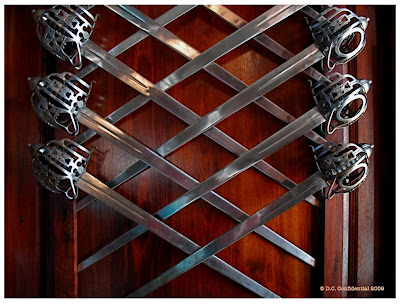
Armaments : Entry Hall at the Governor's Palace : Colonial Williamsburg

Historic, or Colonial, Williamsburg is a 301-acre restored historic area that includes a reconstruction of the Governor's Palace, a munitions bunker, Virginia's first capitol building, Bruton Parish Church (the oldest continuously-operating Episcopal church in America), and the homes and businesses of many of America's early colonialists. Men like George Washington, Patrick Henry, Thomas Jefferson, and others walked these streets or lived here.

Spun and Dyed Yarns in the Rafters : Weaver's Building : George Whyte Plantation : Colonial Williamsburg

I can't say winter is the best time to visit Colonial Williamsburg, though the one advantage is, the crowds are small. I'm told this area is particularly beautiful in the spring and fall, so I have a feeling I'll be going back at some point. A note on the side about this historic place: were it not for the foresight of the Rev. Dr. W.A.R. Goodwin, pastor of Bruton Parish in the 1950s, and the generosity of philanthropist John D. Rockefeller Jr., Williamsburg might not be the preserved historic site it is today.

Detail : Gun Stocks : Armory : Colonial Williamsburg

To see more pictures of Colonial Williamsburg, click on the slideshow below.


Photo copyright: D.C. Confidential, 02/09

Wednesday, February 18, 2009

Historical Strangers

Paul : Aboard the Susan Constant : James River : Jamestown, Virginia

Picking up my 100 Strangers series again, these are just a couple of the volunteers in and around Jamestown and Williamsburg. They're known as historic interpreters and are sometimes referred to as reenactors. They dress in period clothing and provide visitors with important historical information and guidance as we step back 400 years and discover the beginnings of America. This fellow is a guy named Paul who gave us the goods on how 104 men and boys navigated three ships across the Atlantic in 1606-1607 to land in Virginia. I think Paul was from South Africa, because he had the loveliest lilt. What was great about him is, he very obviously loves what he does. His enthusiasm and knowledge were infectious.

Spinner : Whyte Plantation : Colonial Williamsburg, Virginia

I didn't get the name of the historic interpreter in Williamsburg who was spinning linen in the weaver's building behind the estate of George Whyte. Whyte was one of America's lesser known, but significant, signers of the Declaration of Independence. He was also Thomas Jefferson's law tutor. In Colonial America, there were no law schools, so colonialist had to "read the law" with someone who had studied law in Europe. Jefferson read the law with Whyte. Getting back to the weaver's building, though: The reenactors in this building spin and weave blankets and linens and such, which are on display behind and above this spinner.

Photo copyright: D.C. Confidential, 02/09

Tuesday, February 17, 2009

Jamestown 1607

Belfry : Re-creation of the church in Jamestown Fort

Last week, I spent two days out in the states visiting the Historic Triangle of Colonial Virginia. The triangle includes Jamestown, Colonial Williamsburg, and Yorktown in the southeastern region of the Commonwealth of Virginia.

On Thursday, I spent the day in Jamestown, seeing the historic reconstruction and archeological digs of the oldest permanent English settlement in what would later become the United States. Founded on May 13, 1607 by the London Company--later the Virginia Company--Jamestown was the first seat of government in America beginning with the Jamestown Council in 1616.

Rope en suite : Aboard the Susan Constant

In 2007, the Queen of England revisited Jamestown to commemorate the 400th anniversary of the landing of the London Company and the establishment of this settlement. Prior to her recent visit, Her Majesty visited Jamestown in 1957 to mark the 350th anniversary and to participate in the dedication of the site as an official historic monument.

Rope on deck : Aboard the Susan Constant

These are just a few pictures I took aboard the replica of the Susan Constant, one of three ships that carried 104 men and boys across the Atlantic to Virginia. To see more pictures from Historic Jamestown, see the slideshow below.


Photo copyright: D.C. Confidential, 02/09